

Google data center Finland: what the Muhos and Kajaani halt means for site preparation
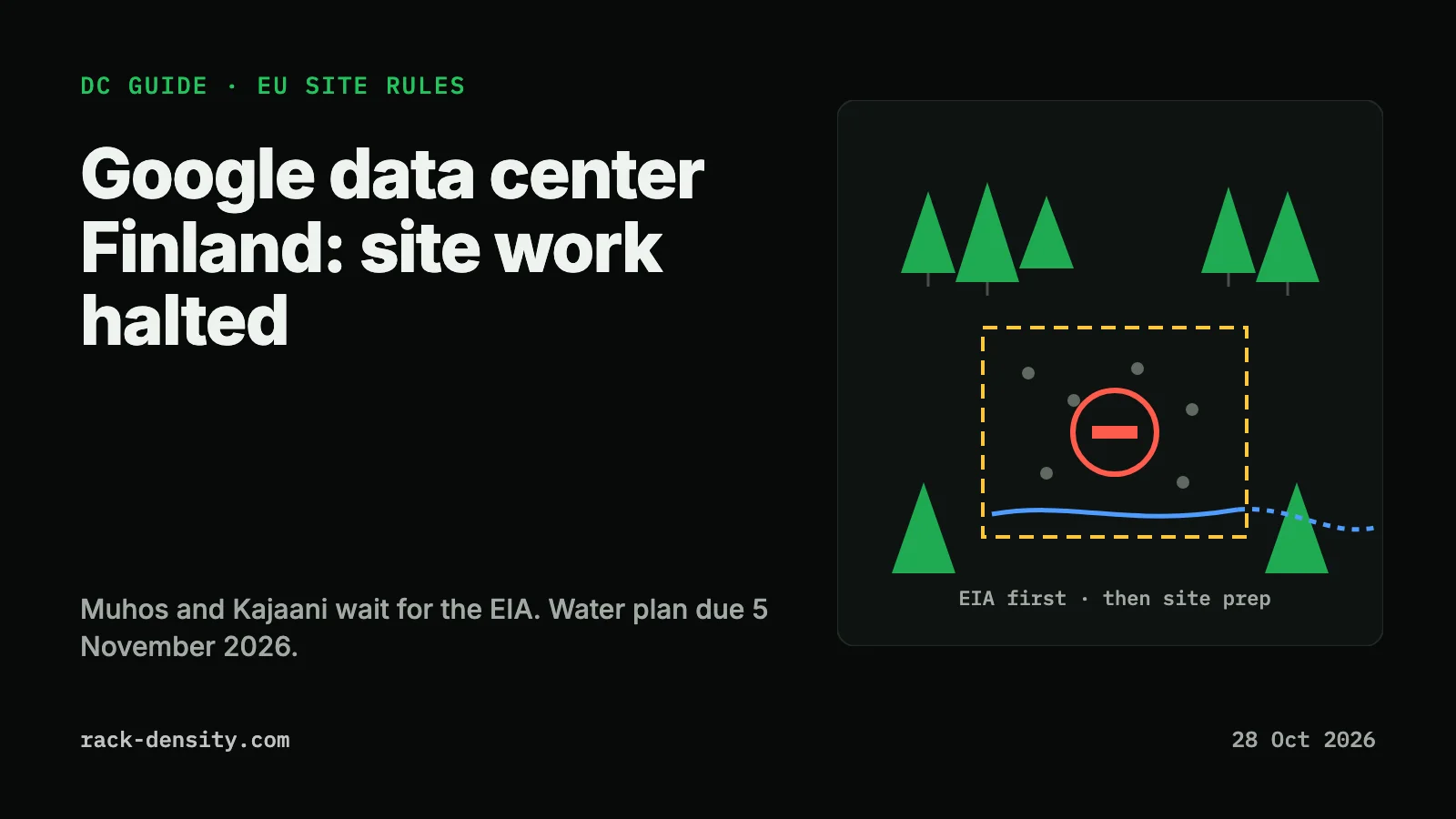
On 6 October 2026 Finland's Licensing and Supervision Authority (LVV) told Tuike Finland Oy, the company developing the Google data center projects in Finland, to stop preparatory work at Muhos and Kajaani until the environmental impact assessments are finished. Tree removal, topsoil stripping, ditching and site roads all count. Tuike stopped by 14 October. The next date is 5 November, when a Muhos water management plan is due.
1. What the regulator ordered
The order came from Lupa- ja valvontavirasto (LVV), Finland’s Licensing and Supervision Authority. In its release of 6 October 2026, LVV asked Tuike Finland Oy to stop preparatory work at the planned Muhos data center and the Kajaani-Otanmäki data center immediately, and by 23 October 2026 at the latest. The pause lasts until the environmental impact assessment (EIA) procedure for each project is complete. LVV based the request on section 32(2) of Finland’s EIA Act and said the assessment reports for both sites are expected in 2026.
LVV had asked Tuike, the Municipality of Muhos and the City of Kajaani for information on 18 September 2026. If Tuike did not comply, the agency said it would consider administrative enforcement, which can carry a conditional fine.
Tuike answered on 14 October 2026. In LVV’s follow-up release of 22 October 2026, the agency says the company would comply and had suspended preparatory work at both sites.
2. What counts as preparatory work
LVV’s 6 October release lists the work that has to stop:
- tree removal and topsoil stripping
- excavation, rock blasting and crushing
- moving earth masses
- drainage ditching and changes to ditches and culverts
- construction site roads and storage areas
- stormwater arrangements
Planning, surveys, soil investigations and other minor work that is easy to reverse can continue. DCD quotes Tommi Muilu, head of LVV’s environment department, saying that these measures change the environment and cause impacts whose identification and assessment are among the key aims of the EIA procedure.
An EIA studies the site before it changes. LVV’s reading is that work which alters the site in ways that cannot easily be undone gets ahead of that study, even when each step looks like ordinary land preparation.
3. The Muhos water issue
The 22 October release adds detail that matters to anyone building on wet, forested land.
Tuike filed a ditching notification for Muhos on 18 September 2026. It covers about nine kilometres of new ditches, most of them already dug. LVV says the notification should have arrived at least 60 days before work started. The agency also concluded that the ditching could cause harm under the Water Act and the Environmental Protection Act, so Tuike now has to apply for a water permit.
LVV also says the Muhos site lies within the impact area of a black shale deposit, where ditching and excavation can oxidise sulphide soils and raise acidity and metal levels. Monitoring results already show changes that point to acidification. LVV considers liming and lime filter dams on their own insufficient and expects sediment and nutrient runoff in heavy rain.
By 5 November 2026 Tuike must deliver a detailed water management plan for Muhos. It has to cover the structures to be built, their locations, a schedule and water monitoring by an independent party, and account for extreme runoff from heavy rain and snowmelt. LVV has also asked for an update on a moor frog breeding and resting site at Muhos. The Kajaani-Otanmäki ditching notification arrived on 29 September 2026 and will be decided separately.
4. Police and the public record
LVV says in the 22 October release that it has asked the police to investigate the Muhos project and that it will not comment further because the matter is confidential. Kaleva reported on 22 October 2026 that police have opened a preliminary inquiry and are assessing, among other things, whether there is reason to suspect environmental damage. Yle reported on 8 October 2026 that a private individual had already filed a request with police on 2 October.
The cleared area is reported differently by each outlet, and LVV’s releases give no figure. DCD reports an estimated 250,000 trees cleared at Muhos and cites The Guardian for almost 330 hectares near the town. Euronews reported on 7 October 2026 that Hanna Halmeenpää, chair of the Finnish Association for Nature Conservation, said more than 300 hectares were logged. Yle describes hundreds of hectares. Futurism, citing The Guardian, wrote on 23 October 2026 that an Otanmäki resident said wolves came into the village after wild animals left the cleared forest.
5. What Google and the government said
Euronews quotes Google spokesman Sondre Ronander: “We understand the concerns and have fallen short of our own high standards in this instance.” He said Google would study LVV’s findings and follow its guidance. Euronews adds that Google says it acted in good faith, carried out environmental surveys and plans tree planting across 130 hectares at Muhos. DCD reports that Google communications manager Michiel Sallaets told the Finnish news agency STT that the logging was done on Google’s own land in line with the Forestry Act.
Environment Minister Sari Multala told Helsingin Sanomat, as quoted by Euronews, that all companies operating in Finland must comply with the law and that in this case that has not happened. Euronews also reports her view that the projects will likely be delayed.
The two sites belong to Google’s 13 billion euro investment in Finnish digital infrastructure over two years, announced on 9 September 2026. Euronews reports that Google calls it its single biggest investment in Europe. DCD reports that Google is developing three data centers in Finland and already runs one in Hamina.
6. What this means for schedules
LVV’s order ties the restart to the end of the EIA procedure. Earthworks, ditching and roads at both sites wait for the assessment reports, which LVV expects in 2026, and then for whatever conclusions and permits follow them. At Muhos a water permit for the ditching also has to come first. None of the outlets we read reported a new construction date, and Google has not published one.
A buyer waiting on capacity from a greenfield campus should treat land preparation as part of the critical path. If a site is still in EIA, the earth moving that a schedule counts as early works can be stopped, and the delay runs until the assessment is done.
7. What to settle before clearing land
The Finnish case gives a practical order of work for a European greenfield data center, drawn from what LVV asked Tuike to do:
- Confirm whether the project is in an EIA procedure, and if so, treat tree felling, topsoil stripping, ditching, blasting and site roads as work that waits for it. Keep to surveys, measurements and soil investigations until then.
- File water notifications early. In Finland a ditching notification is due at least 60 days before work starts, according to LVV, and the authority may still require a full water permit.
- Write the water management plan before the first ditch: structures, locations, schedule, independent monitoring and design for snowmelt and heavy rain.
- Map the soil chemistry. On black shale or acid sulphate ground, LVV’s view at Muhos is that liming alone may not be enough.
- Survey protected species and habitats, such as the moor frog site LVV raised, before any clearing.
- Keep the municipality and its building control in the loop. LVV asked both municipalities for reports before acting.
These steps set when work can start on site, before any power or cooling design is built. Once a schedule is firm, the rack power capacity planning guide helps check whether the capacity you were promised fits the rooms you plan to fill.
8. Dates to watch
- 5 November 2026: the Muhos water management plan and Tuike’s further clarifications on maintenance, security and environmental protection at both sites are due at LVV.
- The Kajaani-Otanmäki ditching decision, which LVV says will follow separately within the statutory deadline.
- The EIA reports for Muhos and Kajaani-Otanmäki, expected in 2026 according to LVV.
- The outcome of the police preliminary inquiry into the Muhos project, reported by Kaleva.
Why did Finland stop Google's data center work?
LVV found that extensive preparatory work had already been done at Muhos and Kajaani while the environmental impact assessments were still running. Under section 32(2) of Finland's EIA Act it asked Tuike Finland Oy, the Google project company, to stop that work immediately and by 23 October 2026 at the latest, according to LVV's release of 6 October 2026.
Where are the Google data centers in Finland?
Google already runs a data center in Hamina, according to DCD. The two halted projects are at Muhos, near Oulu, and at Otanmäki in Kajaani. DCD reports that Google bought 1,400 hectares in Kajaani and Muhos from the state forest agency Metsähallitus in 2024 and 900 hectares in Vaala in February 2026.
How much forest did Google clear in Muhos?
Figures differ by outlet. DCD reports an estimated 250,000 trees at Muhos and cites The Guardian for almost 330 hectares. Euronews quotes the chair of the Finnish Association for Nature Conservation saying more than 300 hectares were logged. LVV's own releases give no area.
Is the Google Finland data center project cancelled?
No. LVV's order pauses preparatory work until the environmental impact assessments are complete; planning, surveys and soil investigations can continue. Euronews reports that Environment Minister Sari Multala said the projects will likely be delayed. LVV expects the assessment reports for both sites in 2026.
What happens on 5 November 2026?
Tuike Finland Oy must send LVV a detailed water management plan for the Muhos site by 5 November 2026, covering structures, locations, a schedule and independent water monitoring, according to LVV's release of 22 October 2026. Kaleva reports that LVV can demand the plan under threat of a fine if it does not arrive.
One Excel file. Your room in 3D.
Download the import template (v1.5, twelve sheets, only Devices required) and the filled example from our demo hall. No form, no email needed, no macros in the files.
Fill in the Devices sheet and send it with your walkthrough request; we import it on the call. What each sheet does