

Imagined — a fictional design built from public numbers. No operator plans this.
Imagined giant · Hydro + seawater AI/HPC campusImagined 1 GW fjord campus — Vestland
Hydro + seawater AI/HPC campus: 1,000 MW IT, 539,136 GPUs, PUE 1.08 — designed by us, checked by the engine
The story
An imagined 1 GW campus cut into a Norwegian fjord side: 4 halls, 104 pods of 72 GB200 NVL72 rack systems with a rear-door heat exchanger on every rack and fjord seawater as the heat sink. Hydropower feeds it at about 20 g CO₂/kWh. The engine reports PUE 1.08 on a July afternoon, and the warm return water is enough to heat a town. A DR site in Stavanger and a North Sea cable to Amsterdam close the estate — cut that cable and see who is left alone.
The numbers
| IT | 1,000 MW |
|---|---|
| Total facility | 1,082 MW |
| PUE | 1.08 |
| Halls / pods | 4 / 104 |
| Racks / GPUs | 7,488 / 539,136 |
| Tokens per second (estimated) | 2,224,656,304 |
| Tokens per kWh (IT, estimated) | 8,012,786 |
| Energy per year | 9,478,320 MWh · about $379 M at 0.04 USD/kWh |
| CO₂ per year | 189,566 t at 20 g/kWh |
| Water (consumptive) | 0 m³/day — seawater heat exchange: no consumptive fresh water (seawater returned warmer) |
| Catalog BOM per pod | $5,900,350 at list prices; not included (no public list price): NVIDIA GB200 NVL72 × 72, Arista 7060X5-64D × 6, Arista 7800R3 Modular Chassis × 2 |
engine on the representative hall (hall.json) at 15:00 local, mid-July, scaled by the pod count; rounded. Token figures are engine estimates, not benchmarks. Energy and CO₂ use the tariff and grid factor in the references below.
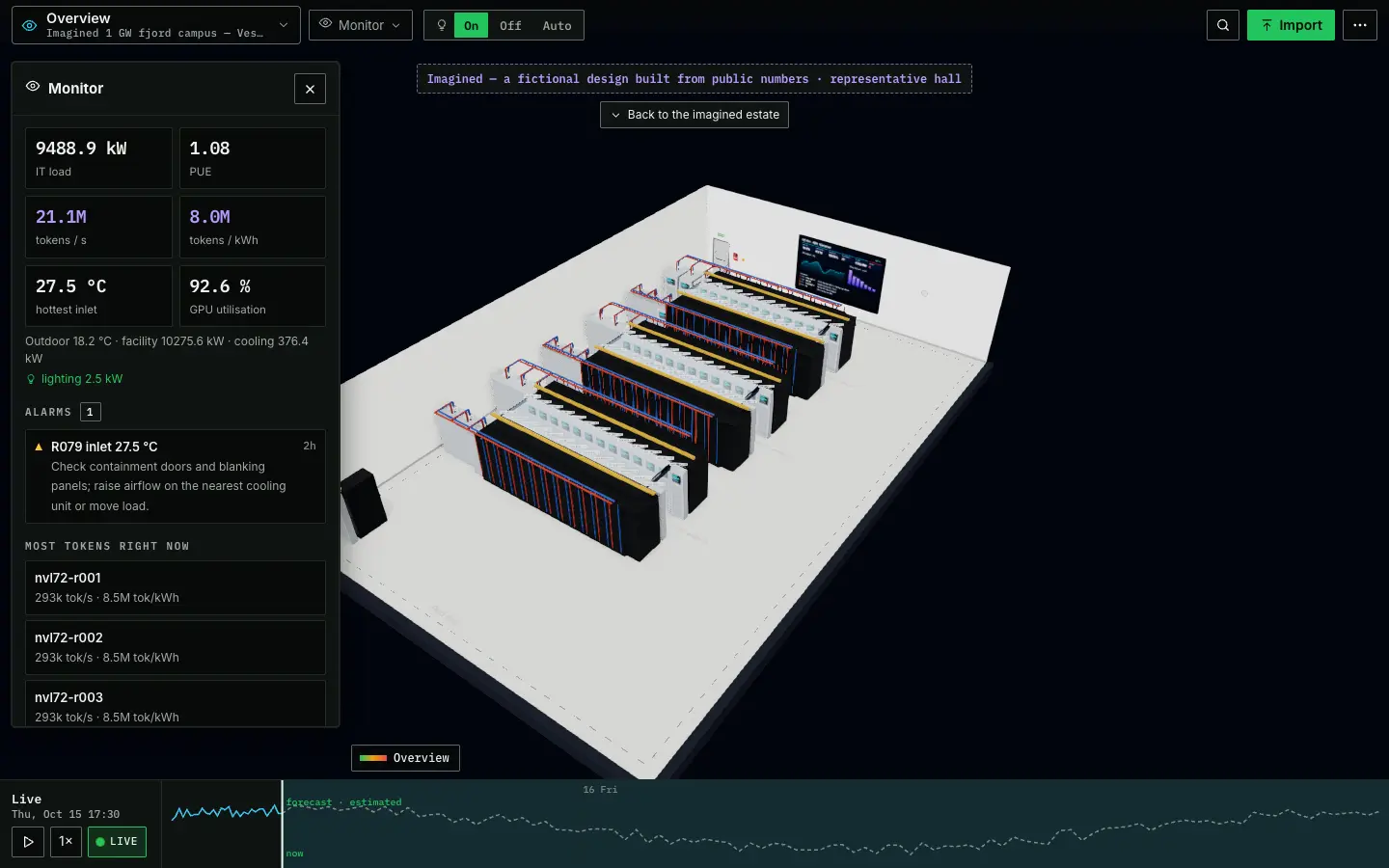
The representative hall
Notable
- 104 pods × 72 GB200 NVL72 rack systems (120 kW each from the catalog) = 539,136 GPUs.
- Per pod the engine sees 9,610.6 kW IT, 10,404.3 kW facility, PUE 1.08 and 21,390,926 tokens/s at the design afternoon.
- 18 CoolIT CHx750 CDUs per pod carry 70 % of the heat as liquid; a Motivair ChilledDoor on every rack take the rest.
- A year at 0.04 USD/kWh: $379 M for 9,478,320 MWh; 190 kt CO₂ at 20 g/kWh.
- Catalog list prices cover 5 of 8 part types per pod; the GB200 NVL72 has no list price in the catalog, so the BOM leaves it out.
What would break (engine)
- Substation trip (utility lost for 15 minutes): Rides through. inlets pass 27 °C after 0:02 (peak 27.8 °C); lowest UPS runtime 9 min. (Substation (400 kV, imagined) lost power (+6 more); UPS bank A on battery · 10 min left (+3 more))
- CDU loop leak at a rack manifold (6 L/min): Outage. 1 devices lose power or trip (72 GPUs); inlets pass 27 °C after 0:01 (peak 27.6 °C); 1.4 L released before isolation; 248.4 M tokens lost. (Leak at Manifold R001 · 0 L released; Manifold R001 isolated after leak; nvl72-r001 throttled to 20 %; nvl72-r001 thermal shutdown)
- Trunk cable cut (BGO-IX ↔ AMS-IX): BGO-IX ↔ AMS-IX cut, not protected — 8000 Gb/s rerouted via FJD-DR–AMS-IX, FJD-1–FJD-DR, FJD-1–BGO-IX (16 ms instead of 13.4) · FJD-1 ↔ FJD-DR would need 160 % — congested
What we assumed and why
- Scale: 1,000 MW IT target from the brief (IMAGINED-GIANTS.md §1); the pod count is that target ÷ the engine's pod IT load.
- Rack system: catalog record rack_system/nvidia/gb200-nvl72, 120 kW IT, 72 GPUs, 70 % liquid-cooled (catalog thermal data).
- Cooling: cdu/coolit/chx750 CDUs (750 kW, catalog) in loops of 3 per row, N+1; heat rejected to fjord seawater; rear_door_hx/motivair/chilleddoor rear doors (75 kW) for the air share.
- Power: 2N from a 400 kV substation through ATS (grid / genset bank), transformers, switchboards and MW-class UPS banks (generic nodes: no MW-class UPS in the catalog), busway taps per rack; standby genset banks of Cat 3516C (2 MW standby, catalog); hydro grid feed; diesel standby.
- Climate: a July day at 15 °C mean with a 6 °C daily swing and 78 % RH (typical July climate for the region); the numbers are read at 15:00 local, the warmest hour.
- Grid factor 20 g CO₂/kWh and tariff 0.04 USD/kWh: dc-world/reports/giants-references.md §2 / §3.
- Tokens: every rack serves a 70B chat model at 70–95 % load (engine estimate from GPU memory bandwidth and FLOPS; labelled estimated, not a benchmark).
- Water: seawater heat exchange, no fresh-water consumption (evaporative trim not modelled).
- Estate: the DR and peer sites, link capacities and carriers are part of the imagined design, not real contracts; latency is estimated from distance.
- References for scale, cooling and power patterns: §2.3 Norway NO2/NO3: ~20 g/kWh, €0.032–0.050/kWh; dc-world sites: Green Mountain SVG-Rennesøy (fjord water), Lefdal Mine (fjord water) for the cooling pattern (dc-world/reports/giants-references.md).
The estate
| From | To | Type | Bandwidth | Protected | Est. one-way latency |
|---|---|---|---|---|---|
| FJD-1 | BGO-IX | dark fibre | 12,800 Gbps | true | ≈ 0.7 ms |
| FJD-1 | FJD-DR | dark fibre | 6,400 Gbps | true | ≈ 1.8 ms |
| BGO-IX | OSL-IX | terrestrial | 6,400 Gbps | true | ≈ 2.3 ms |
| BGO-IX | AMS-IX | submarine | 20,000 Gbps | false | ≈ 6.7 ms |
| FJD-DR | AMS-IX | submarine | 10,000 Gbps | false | ≈ 5.5 ms |
Files
- estate.xlsx — Sites and Links (DC Sim template v1.4)
- hall.xlsx — the representative hall, device by device
- giant.json — the record with derived numbers and assumptions
Public reference numbers: mega-campus references. CC BY 4.0. Imagined — a fictional design built from public numbers.
Is Imagined 1 GW fjord campus — Vestland a real data center?
No. Imagined — a fictional design built from public numbers. No operator plans it; it shows what such a campus would need, using catalog devices and public reference numbers.
Where do the numbers come from?
engine on the representative hall (hall.json) at 15:00 local, mid-July, scaled by the pod count; rounded. Assumptions and the public references are listed on this page.
What happens if substation trip (utility lost for 15 minutes)?
Rides through. inlets pass 27 °C after 0:02 (peak 27.8 °C); lowest UPS runtime 9 min.