

Telehouse Docklands 65 MW: how central London campuses navigate grid limits
Telehouse is expanding its London Docklands campus by 65 megawatts across Telehouse South and surrounding plots, navigating intense UK substation capacity queues. Central London metro operators must balance rising high-density rack loads against Greater London transmission constraints, heat export mandates, and substation wait times exceeding five years.
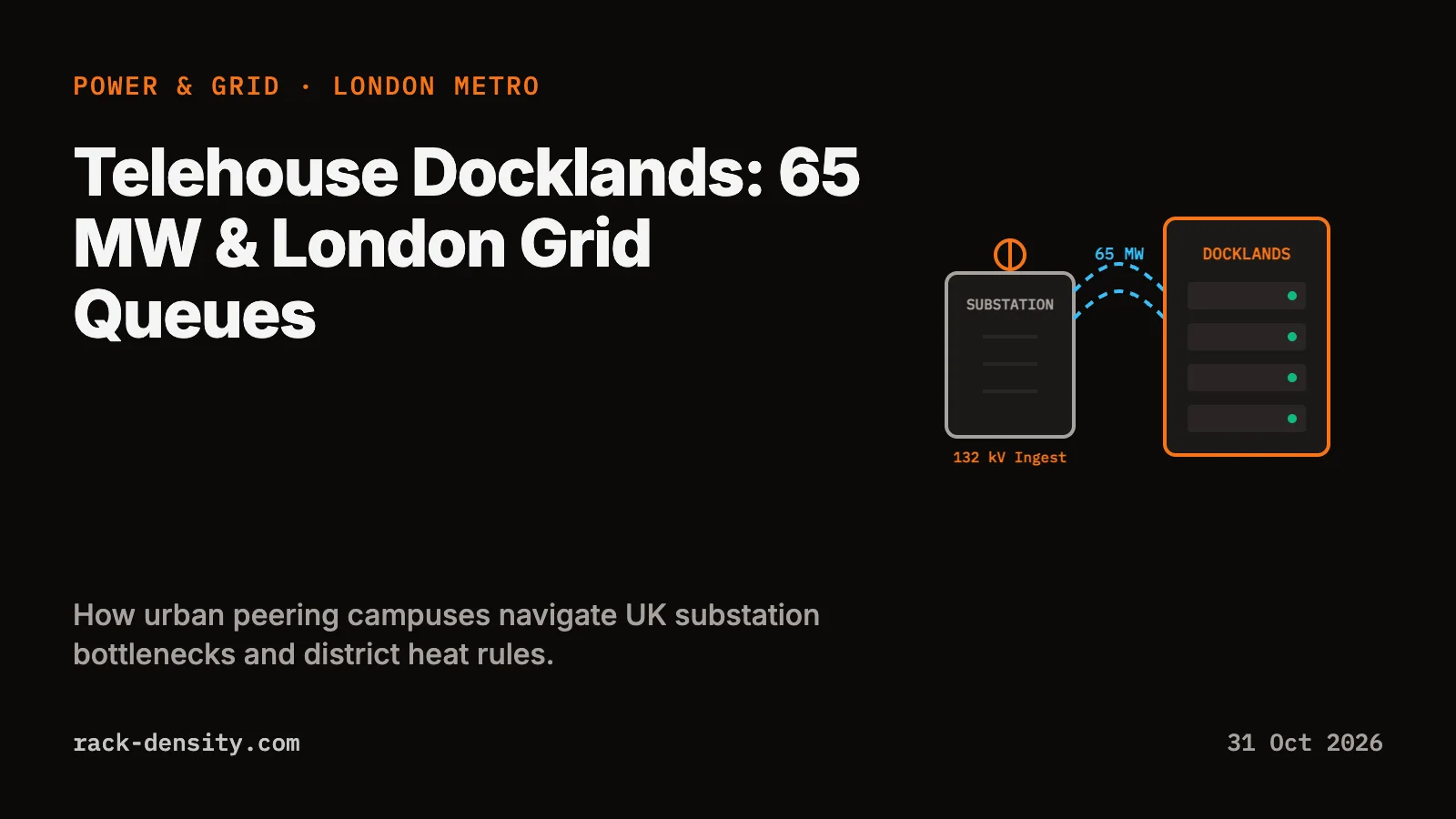
1. The Docklands campus expansion
Telehouse has advanced its 65-megawatt capacity expansion across its London Docklands campus in late October 2026. The Docklands site, which hosts the primary peering hub for the London Internet Exchange (LINX), represents one of Europe’s most densely interconnected communications hubs.
The expansion adds substantial capacity through the continuous fit-out of Telehouse South (formerly the Thomson Reuters building) and associated infrastructure plots. Adding 65 MW within London’s primary metro core demonstrates the high premium financial institutions and enterprise networks place on low-latency connectivity, even as suburban and regional zones restrict power access.
2. Greater London grid bottlenecks
Building large-scale capacity inside the M25 ring road faces severe infrastructure limits. In West and East London, major distribution substations operated by UK Power Networks and the National Grid have reached saturation.
Developers requesting tens of megawatts for new greenfield builds regularly receive connection offers dated past 2032. Campuses that secured historical grid allocations or phased capacity agreements years earlier, such as Telehouse Docklands, can expand while competitors wait in multi-year transmission queues.
Metro density forces operators to extract the maximum revenue from each contracted megawatt. Instead of spreading average loads across thousands of low-density cabinets, new halls are engineered for mixed densities ranging from standard 8 kW network racks to 40 kW compute clusters.
3. Cooling transitions and urban heat mandates
Operating 65 MW of dense compute in a marine-adjacent urban environment introduces cooling challenges. Water usage is constrained by municipal cost, while external noise ordinances in Tower Hamlets prevent noisy rooftop chiller arrays.
Operators adapt by implementing direct-to-chip liquid cooling loops and closed-circuit evaporative coolers. Heat capture also plays an increasing role in planning consent: the Greater London Authority planning framework requires new and expanding facilities to evaluate connections to local district heating networks, transferring thermal exhaust to residential developments.
4. Metro connectivity versus regional scale
The Telehouse expansion highlights the widening divide in European infrastructure. While hyperscale training clusters migrate to regional locations with abundant renewable power, core interconnection facilities remain anchored in metro downtowns.
For enterprise infrastructure planners, securing metro capacity requires early reservation and high rack efficiency. When grid upgrades take years to arrive, every kilowatt inside the facility must be carefully managed and measured.
How much capacity is Telehouse adding to London Docklands?
Telehouse is deploying up to 65 megawatts of additional IT load capacity across its Docklands campus, anchored by the phased expansion of Telehouse South and adjacent facility upgrades.
Why is power constrained in the London data center market?
The Greater London electrical grid faces severe transmission bottlenecks. National Grid ESO and distribution network operators have placed new large-scale power applications into queue windows stretching into the 2030s.
How do metro campuses handle rising rack densities?
Campuses like Docklands transition from air cooling to liquid-to-air and direct-to-chip liquid cooling loops to support rack densities exceeding 40 kW without requiring expansive floor footprints.
Are heat export networks mandatory for London data centres?
The Greater London Authority and local borough planning guidance require major data centre projects to assess and integrate district heating connections where municipal heat networks operate.
One Excel file. Your room in 3D.
Download the import template (v1.5, twelve sheets, only Devices required) and the filled example from our demo hall. No form, no email needed, no macros in the files.
Fill in the Devices sheet and send it with your walkthrough request; we import it on the call. What each sheet does